Why Point of Care Access Is the Missing Piece in Hand Hygiene Compliance

Why Point of Care Access Is the Missing Piece in Hand Hygiene Compliance

Most healthcare workers already know when they should clean their hands. So why does compliance so often fall short? Usually it's not a knowledge gap — it's an access gap. If a dispenser is down the hall, a busy provider moving between patients is far less likely to use it. Making hand hygiene tools available exactly where care happens is one of the simplest, most overlooked ways to close that gap.

Why Hand Hygiene Matters

Hand hygiene is the single most effective way to prevent healthcare-associated infections (HAIs). HAIs are linked to prolonged hospital stays, long-term disability, antimicrobial resistance, poor outcomes, added costs, and unnecessary deaths. The connection to compliance shows up clearly in the data: a multi-year study in Finland tracking over 52,000 observations found that as annual compliance rose from 76.4% in 2013 to 88.5% in 2018, HAIs fell from 2,012 cases to 1,831 over the same period. Yet compliance remains inconsistent—one Tunisian study found compliance improved from 21% to 40% over four years, still short of WHO's 80% target even after training. Knowledge alone doesn't close that gap—access does.

The 5 Moments for Hand Hygiene

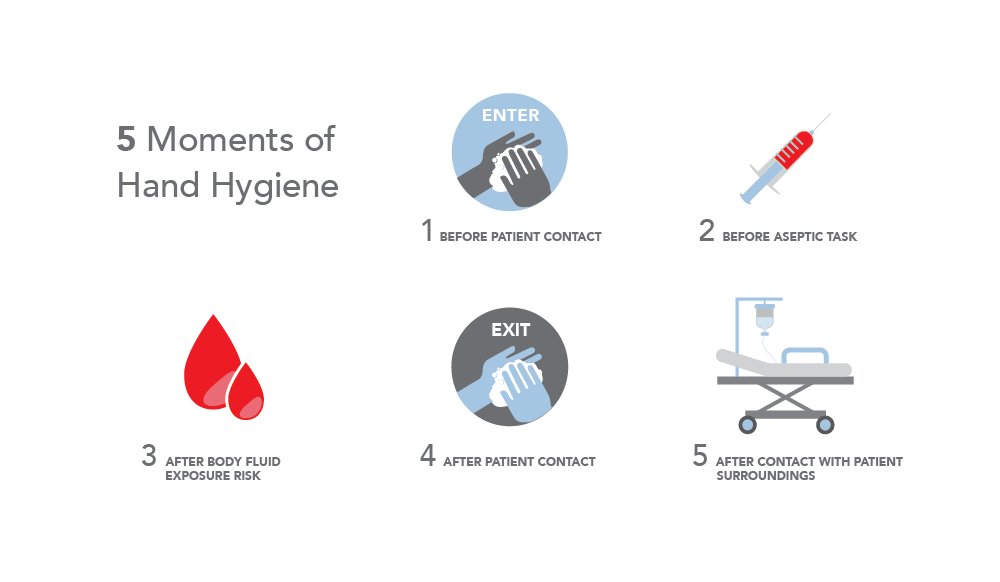
The WHO's "5 Moments" framework defines exactly when hand hygiene is needed during patient care:

1. Before Patient Contact

2. Before an Aseptic Task

3. After a Body Fluid Exposure Risk

4. After Patient Contact

5. After Contact with Patient Surroundings

These moments mark the points where transmission risk is highest, which is why *where* the product sits matters as much as knowing the rule. One large study found compliance was weakest at Moment 1, with rates around 55.8% versus 79.1% for Moment 5—the exact moment a provider is entering a room and may not have a dispenser at hand.

Closing the Gap: Point of Care Access

"Point of care" refers to the moments a provider is in direct contact with a patient or their environment. Putting hand hygiene products in that exact zone, rather than requiring a walk to a wall-mounted station, removes the biggest barrier to compliance: convenience. As Dr. William Parks, CMO of Memorial Hermann the Woodlands, put it, “If a product isn't convenient in the moment, staff won't go out of their way to find it.”

The APIC Implementation Guide frames the goal well: hand hygiene should be available in the "patient zone" — where the patient, provider, and environment intersect. That zone includes the hospital's most contaminated high-touch surfaces: bedrails, bed surfaces, supply carts, over-bed tables, and IV pumps.
How Symmetry Point of Care Tools Support the 5 Moments

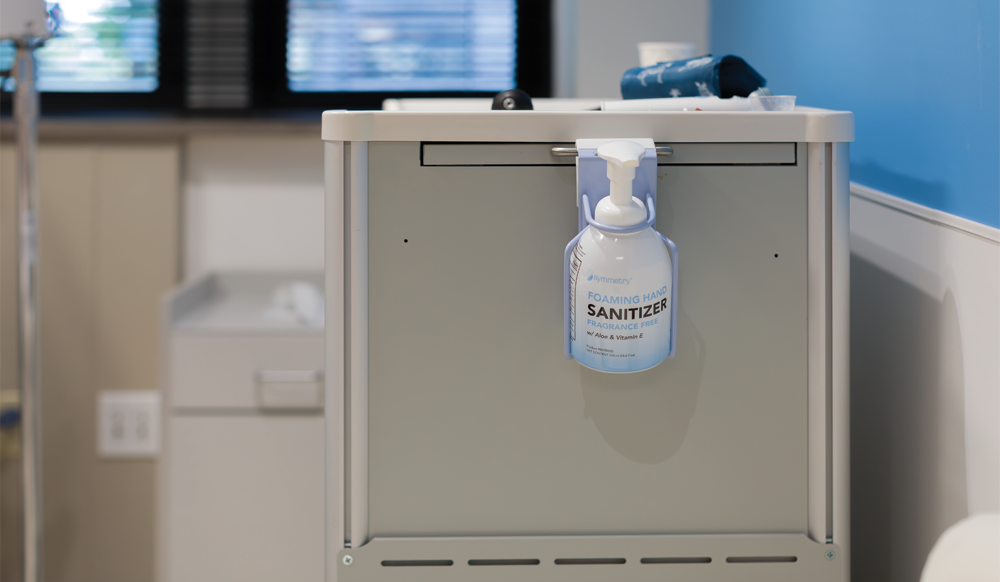
Symmetry's Point of Care line puts sanitizer within arm's reach at exactly these moments:

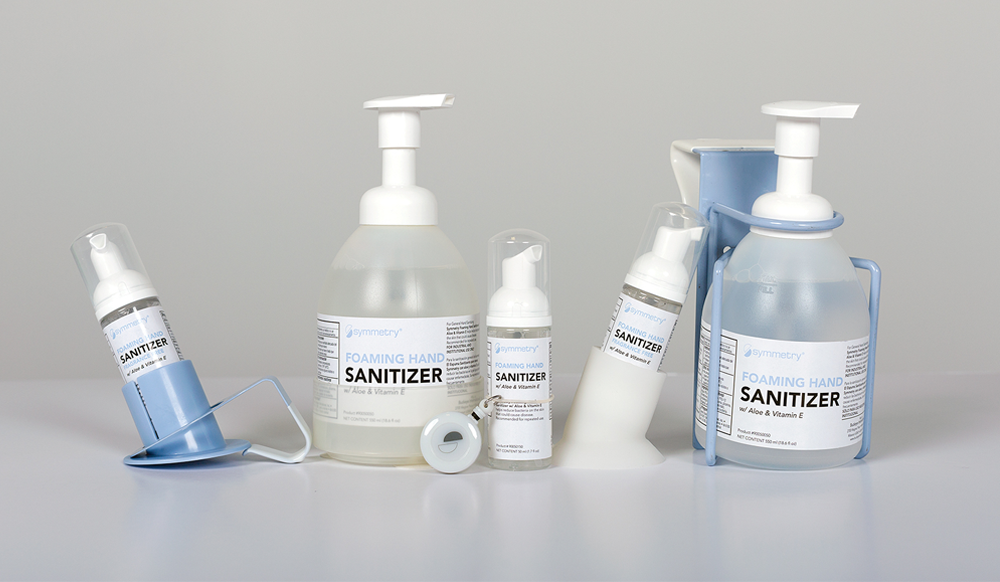
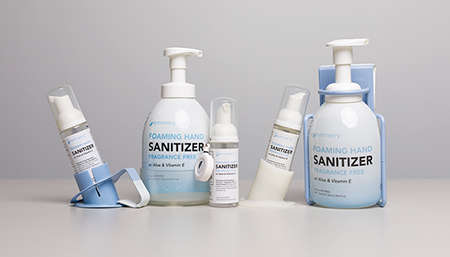
  • 50 ml Tray Table / W.O.W. Clip — attaches to a workstation-on-wheels, traveling with the provider room to room
  • 50 ml / 550 ml Suction Cup — mounts near the bedside without permanent installation
  • 550 ml Wire Bracket — fixed placement in a patient room or care area
  • 550 ml Anesthesia Cart Bracket — built for procedural/surgical settings
  • 50 ml Lanyard — worn by the provider, so sanitizer is always on hand

A lanyard or clip supports Moment 1 by traveling with the provider into every room. Bedside mounts support Moments 2 and 3, keeping sanitizer ready before an aseptic task or after a fluid exposure risk. And because these tools live in the patient zone, they also reinforce Moments 4 and 5 as the provider leaves.

The Bottom Line

Hand hygiene compliance is less an education problem than a design problem. The 5 Moments tell providers when hygiene matters most; point of care tools make it realistic to act on that knowledge consistently, patient after patient.

Contact your representative to learn more about how Symmetry Point of Care Tools can improve compliance in your healthcare facility.
APIC 2025

APIC 2025

We can’t wait to see you at APIC 2025! The APIC Annual Conference & Expo is the premier event for infection preventionists, and Symmetry is proud to be a part of it. As hand hygiene remains one of the most effective ways to reduce healthcare-associated infections (HAIs), Symmetry continues to lead with innovative solutions that support healthy hand hygiene behaviors and better skin health.

Why APIC Matters?

The APIC Conference is where infection prevention professionals come together to share best practices, explore new technologies, and shape the future of infection control. It's also an important time to recognize the critical role of infection preventionists and provide them with the tools they need to succeed and help decrease the spread of diseases.

At APIC 2025, Symmetry is excited to showcase the latest in hand hygiene innovation, including:

Symmetry’s Green Certified Hand Wash SMT

A foaming hand wash formulated with Skin Moisturizing Technology that is designed for repeated use by healthcare clinicians.

Point of Care Tools

Symmetry’s Point of Care tools are designed to keep hand hygiene options available within reach at critical moments. This year at APIC, Symmetry is showcasing tools to help reduce cross-contamination by making compliance easy and accessible.

Behavior Modification System

Encouraging users is essential, and Symmetry provides tools that spread awareness through visual and audio cues that are designed to engage and encourage hand hygiene practices.

Improved Skin Health

Harsh soaps and frequent handwashing can lead to skin irritation, which often reduces compliance. This year at APIC, come see how our products improve your skin health even after repeated washing and drying of hands.

Creating a Culture of Compliance

True hand hygiene success happens when compliance becomes part of the culture. Symmetry provides the tools, education, and support to help facilities build sustainable programs that empower infection preventionists and protect patients.

Acceptance = Compliance = Lower HAIs

Improving hand hygiene compliance starts with providing products that clinicians want to use. Symmetry hand hygiene products are gentle, effective, and designed to increase compliance and help lower HAIs.

We can’t wait to see you at APIC this year. Visit us at Booth 726  

Want more information? Visit APIC or contact a Buckeye representative.

World Hand Hygiene Day

World Hand Hygiene Day

Celebrate World Hand Hygiene Day with us! Infection Preventionists around the world are doing so much to reduce the spread of disease in healthcare facilities and beyond. We want to show our thanks by promoting healthy hand hygiene practices.

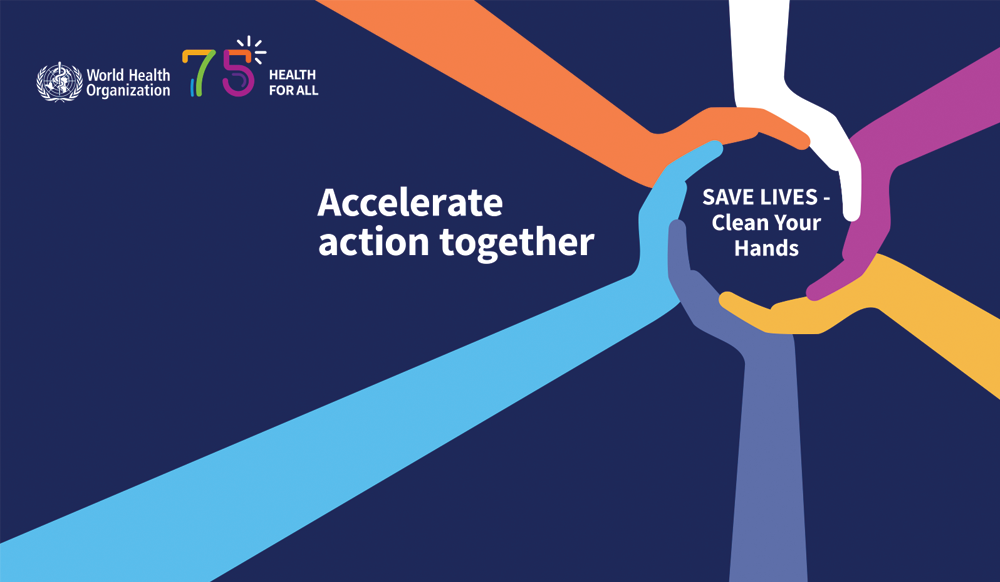
This year, the World Health Organization’s slogan for World Hand Hygiene Day is, “Accelerate action together. SAVE LIVES – Clean Your Hands.” Their aim is to improve hand hygiene at point of care by reminding healthcare workers to love the 5 Moments.

What are the 5 Moments? 

The 5 Moments for Hand Hygiene are key moments when healthcare workers should perform hand hygiene. This evidence-based, field-tested, user-centered approach is designed to be easy to learn, logical, and applicable in a wide range of settings.

  1. Before Patient Contact
  2. Before Aseptic Task
  3. After Body Fluid Exposure Risk
  4. After Patient Contact
  5. After Contact with Patient Surroundings

Reducing the spread of HAIs begins with clean hands. Healthcare staff members, patients, and visitors can all benefit when hands are cleaned during the 5 moments.

Improving Hand Hygiene at Point of Care 

Point of Care refers to the moments when healthcare workers are in contact with patients and are at the highest risk of spreading infections. This includes most of the 5 Moments for Hand Hygiene. By increasing opportunities for hand hygiene at Point of Care, healthcare facilities can keep hand sanitizer and hand wash available at key times, including before and after patient contact. 

Due to the high risk of the spread of HAIs, the Joint Commission recognizes individual failure to follow hand hygiene procedures during point of care as a deficiency. This means that a complete hand hygiene program includes Point of Care tools that give healthcare workers easy access to hand hygiene opportunities while working directly with patients. 

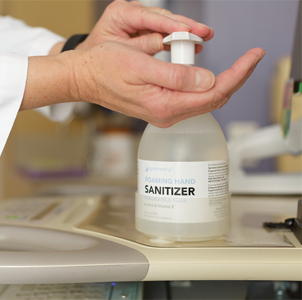
Access to hand sanitizer at a W.O.W., tray table, anesthesia cart, or on your person makes hand hygiene more convenient for workers. Symmetry® offers Point of Care options for all of these and more:

  1. Tray Table/W.O.W. to ml
  2. Suction Cup 550 ml
  3. 50 ml Lanyard
  4. Suction Cup 50 ml
  5. Anesthesia Cart Bracket 550 ml

Hand hygiene is a year-round commitment for healthcare facilities. We thank our Infection Preventionists this World Hand Hygiene Day for the work they do all year long to keep us safe.

Contact your local representative to see how these tools can help improve compliance in your facility.

Maintenance Products, Programs, and Training for Healthcare Facilities

Maintenance Products, Programs, and Training for Healthcare Facilities

Combatting the spread of HAIs (healthcare associated infections) in healthcare facilities is a complex task that requires a multi-faceted approach. Hospitals and other healthcare facilities require an effective cleaning and maintenance program to protect staff, visitors, and patients from the spread of germs and illness.

Hand Hygiene 

The CDC states that hand hygiene is one of the most important steps in reducing the spread of germs. Making hand sanitizer and hand washes readily available to staff and visitors can help reduce the risk of the spread of germs, but there are other ways an effective hand hygiene program can combat disease.

In addition to top-of-the-line products, offering education and awareness materials alongside behavior modification tools that inspire immediate hand hygiene practices can increase compliance rates in healthcare facilities.

The Symmetry® Hand Hygiene Program offers those tools and more. Symmetry’s Point of Care tools make hand hygiene available when it’s needed most. For example, the 50 ml Tray Table/W.O.W. Clip puts sanitizer right at the patient’s bedside for easy access before and after patient care.

Cleaning and Disinfecting 

Proper cleaning and disinfecting procedures can have a huge impact on the spread of germs in any healthcare facility. The Buckeye Eco® Proportioning Program simplifies cleaning and disinfecting with automatic dilution, ensuring important products like disinfectants are properly diluted every time.

Eco products include cleaners, disinfectants, and sanitizers for every surface in a hospital or healthcare facility. EPA expects products on List N to kill all strains and variants of the coronavirus SARS-CoV-2 (COVID-19) when used according to the label directions. All Eco disinfectants are on List-N.

However, a cleaning program is not complete without the proper training. Cleaning and disinfecting procedures need to be followed carefully so areas like patient rooms and hospital waiting rooms remain free of germs. To ensure hospital staff have access to the information they need, Buckeye created the Prescription Training Program.

Prescription is a complete maintenance program for hospitals that presents the products, procedures, and training needed to meet your facility’s highest standards. The Prescription program provides training in routine cleaning, patient room cleaning, surgery room cleaning, restroom, carpet care, hard floor care, and product safety. This program and its resources are available online, 24 hours a day.

Reducing the spread of HAIs is a constant battle. Make sure the people in your healthcare facility have access to the tools they need to combat illness. Contact your local sales representative to learn more.

International Infection Prevention Week (IIPW) 2022

International Infection Prevention Week (IIPW) 2022

This week is International Infection Prevention Week (IIPW). Established in 1986, IIPW raises awareness of the role infection prevention plays in improving patient safety. This year’s theme, “The Future is Infection Prevention: 50 Years of Infection Prevention”, aims to show appreciation for APIC’s past work in infection prevention while inspiring new IPs to continue this important work.

Though there are many ways to reduce the spread of healthcare associated infections (HAIs), the most important way is to clean your hands. Symmetry strives to reduce HAIs with gentle products that people want to use in reliable dispensing systems.

Symmetry’s programmatic approach to hand hygiene educates and encourages proper hand hygiene practice with educational tools, the Symmetry Behavior Modification System, and Point of Care tools. Its education and awareness tools include posters and wall charts, designed to explain the “How” and “Why” of proper hand hygiene. The Symmetry Behavior Modification System consists of a series of unique placards and signs with messages designed to inspire and maximize hand hygiene practices. Symmetry Point of Care items include suction cups, brackets, and lanyards that make it possible to access hand sanitizer while workers are in contact with patients and are at the highest risk of spreading germs.

On behalf of Symmetry and Buckeye International, we’d like to thank our IPs for the work they continue to do while fighting COVID-19, the flu, and other healthcare associated infections. International Infection Prevention Week happens every third week of October, but infection prevention is a full-time job. Check out all of the tools APIC provides to keep you informed about infection prevention here.

Contact your local representative for more information about Symmetry products and how a complete hand hygiene program can improve compliance in your facility.

Hand Hygiene Compliance: Point of Care

Hand Hygiene Compliance: Point of Care

Due to the high risk of the spread of HAIs, the Joint Commission recognizes individual failure to follow hand hygiene procedures during point of care as a deficiency. Point of Care refers to the moments when healthcare workers are in contact with patients and are at the highest risk of spreading infections. If a deficiency is recognized, it will result in a Requirement for Improvement (RFI) under the Infection Prevention and Control (IC) chapter for all Joint Commission accredited programs. All RFIs must be addressed before an organization is accredited.

Facilities can increase hand hygiene compliance, reduce the spread of germs, and improve HCAHPS scores with Symmetry® Point of Care items. Symmetry Point of Care items give healthcare workers easy access to hand hygiene opportunities while working directly with patients.

5 Moments for Hand Hygiene

The World Health Organization has identified 5 moments for hand hygiene. These 5 moments define key times when healthcare workers should perform hand hygiene. This evidence-based, field-tested, user-centered approach is designed to be easy to learn, logical and applicable in a wide range of settings, including at point of care.

  1. Before Patient Contact – Clean your hands before touching a patient when approaching him or her.
  2. Before Aseptic Task – Clean your hands immediately before performing a clean/aseptic procedure.
  3. After Body Fluid Exposure Risk – Clean your hands immediately after an exposure risk to body fluids (and after glove removal).
  4. After Patient Contact – Clean your hands immediately after touching a patient and his or her immediate surroundings when leaving.
  5. After Contact with Patient Surroundings – Clean your hands after touching any object or furniture in the patient’s immediate surroundings, when leaving – even without touching the patient.

Point of Care Tools 

The Symmetry Hand Hygiene Program’s Point of Care Tools are designed to be readily available as a healthcare professional cares for a patient. During the 5 Moments for Hand Hygiene, Symmetry’s Point of Care Tools keep hand sanitizer nearby for ease of use.

In hospitals, often the most contaminated high touch surfaces are bed rails, bed surfaces, supply carts, over-bed tables, and intravenous pumps. Point of Care Tools can be placed on or near these surfaces to provide healthcare workers, patients, and visitors the opportunity to clean their hands immediately after contact.

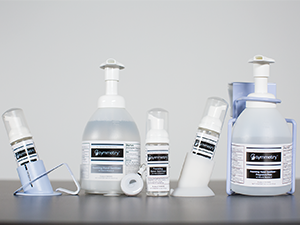
Symmetry Point of Care Tools include 50 ml Tray Table/W.O.W.s, 550 ml Suction Cups, 50 ml Lanyards, 50 ml Suction Cups, and 550 ml Anesthesia Cart Brackets.

Contact your local Buckeye representative to find out more information about Symmetry’s Point of Care Tools and how Symmetry can improve hand hygiene compliance in your healthcare facility. 
Increasing Compliance in Acute Care and throughout the Continuum of Care

Increasing Compliance in Acute Care and throughout the Continuum of Care

What steps can you take to increase hand hygiene compliance, reduce the spread of germs, and enhance the safety of the patient population?

The Symmetry® Hand Hygiene Program provides the tools to help stop the reduce of HAIs (Healthcare Associated Infections), including employee-preferred hand hygiene products, Behavior Modification tools, and Point of Care tools.

Symmetry products clean and are less likely to contribute to dry hands. They don't leave a sticky residue and reduce common disease-causing bacteria. When surveyed, 97% of healthcare workers prefer Symmetry products over their previous hand hygiene products. They are gentle on hands, leave them feeling soft and refreshed, and rinse easily making it easy to apply gloves.

In addition to providing the best products for clinicians, Symmetry knows that one of the best ways to encourage hand hygiene compliance is through the use of other tools such as the Symmetry Behavior Modification System (SBMS). Symmetry Behavior Modification tools include colored dispensers, Behavioral Driver Placards, and signs with messages designed to maximize hand hygiene practices.

Symmetry also offers Visual Lighting Cues (VLCs) for dispensers. The American Journal of Infection Control (AJIC) published a study that measured hand hygiene compliance using visual lighting cues. The study concluded that a flashing light affixed to hand hygiene dispensers drew attention to the dispenser, and approximately doubled hand hygiene compliance.

For healthcare facilities looking to improve hand hygiene compliance to reduce the spread of germs, utilizing Symmetry’s Behavior Modification tools can draw attention to opportunities for hand hygiene, but Behavior Modification tools are not the only way to improve hand hygiene practices. Symmetry also offers Point of Care tools for moments when healthcare workers are in contact with patients and at the highest risk of spreading germs.

Point of Care tools are specifically designed so that healthcare workers have access to hand sanitizer during the 5 moments for hand hygiene. The World Health Organization (WHO) defines these moments as before patient contact, before aseptic task, after body fluid exposure, after patient contact, and after contact with patient surroundings.

Symmetry’s Point of Care tools include 50 ml patient tray table/ W.O.W. clips, 550 ml suction cup, 50 ml lanyard, 50 ml suction cup, and 550 ml anesthesia cart bracket. For nurses and other healthcare workers coming in contact with patients, these tools make hand hygiene products immediately available and convenient.

A complete hand hygiene program provides all the tools necessary to reduce the spread of germs and bacteria in healthcare facilities. Tools that can spread awareness and simplify the hand hygiene process for workers can assist in creating a cleaner environment for patients, visitors, and staff members.

For more information on the kinds of tools Symmetry can provide to healthcare facilities, contact your local Buckeye representative.

Help Reduce the Spread of Germs with Symmetry

Help Reduce the Spread of Germs with Symmetry

“Many HAIs (healthcare-associated infections) are transmitted by healthcare personnel, and hand hygiene is a primary means to reduce these infections.” – Health Research & Education Trust, affiliate of the American Hospital Association

Hand hygiene noncompliance is a major contributor to the spread of HAIs. It’s also one of the easiest practices to improve. Symmetry’s goal is to provide products that healthcare workers want to use. With reliable dispensers and better products, healthcare workers are more likely to follow hand hygiene compliance policies.

Symmetry products are less likely to contribute to dry hands or leave sticky residue behind. Through clinical evaluation, Symmetry consistently proves to be the preferred choice of healthcare workers. Because Symmetry provides products that healthcare workers prefer, workers are more likely to clean their hands and help reduce the spread of germs.

To keep hand hygiene on the minds of staff, visitors, and patients, Symmetry offers the Symmetry Behavior Modification System (SBMS). SBMS utilizes behavioral science to drive hand hygiene compliance. With unique tools based on the six key tenets of benevolence, accountability, responsibility, variation, emotion, and direction, SBMS inspires immediate hand hygiene practices.

Symmetry also uses point of care tools to focus on the five moments for hand hygiene. The five moments for hand hygiene approach defines key moments when healthcare workers should perform hand hygiene. Symmetry’s point of care tools include suction cups, lanyards, and cart brackets to give healthcare workers easy access to hand hygiene opportunities while working directly with patients. 

The tools of the Symmetry® Hand Hygiene Program make it easier for healthcare workers to access Symmetry products. They keep hand hygiene on the minds of people throughout healthcare facilities and help convey the importance of hand hygiene. Contact your local Buckeye representative for more information on how Symmetry can help healthcare facilities fight HAIs.

What Are You Doing for Point of Care?

What Are You Doing for Point of Care?

The 5 Moments of Hand Hygiene approach defines key moments when healthcare workers should perform hand hygiene. Washing or sanitizing hands before or after these moments helps protect the patient, workers, and the healthcare environment against the spread of germs.

5 Moments of Hand Hygiene

These moments often occur when a healthcare worker is in direct contact with a patient. For hand hygiene needs during patient contact, the Symmetry® Hand Hygiene Program provides Point of Care tools. Point of Care tools are strategically placed to provide healthcare workers with hand hygiene options while caring for a patient. They can help reduce the spread of germs by tackling hand hygiene in areas that pose the highest risks.

“The aim of point of care availability is to provide access to hand hygiene products in the ‘patient zone’ – the location where the patient and healthcare personnel and environment intersect.” APIC Implementation Guide: Guide to Hand Hygiene Programs for Infection Prevention

Symmetry Point of Care items include:

*Suction Cups contain Ionpure, an antimicrobial agent approved by the FDA, EPA, and NSF.

In combination with other key features of the Symmetry Hand Hygiene Program like education and awareness tools and behavior modification tools, Symmetry Point of Care tools provide a reminder to healthcare workers about the importance of hand hygiene during key moments. Symmetry’s goal is to provide your facility with all the tools needed to help reduce the spread of germs.

Contact your local representative to find out more about the program and to see how you can improve point of care hand hygiene in your facility.